
Contents
- Does a timber-frame house burn? Where the fear comes from
- Four myths about timber-frame house fire safety
- What the wall is made of and how it behaves in a fire
- Where fires really start
- Fireplace, boiler and generator: what to consider
- What to keep at home in case of fire
- Safety on the plot
- What to ask your builder
- A safe timber-frame house: where to start
- Timber-frame house fire safety: FAQ
Any house can catch fire, whether it is built of brick, aerated concrete or timber. The difference lies elsewhere: how quickly the fire spreads and how much time there is to put it out or get outside. That is what fire safety really means, not the wall material on its own.
In this article we explain how fire safety works in a timber-frame house, where the myths about timber-frame houses come from and what to look out for when choosing a design.
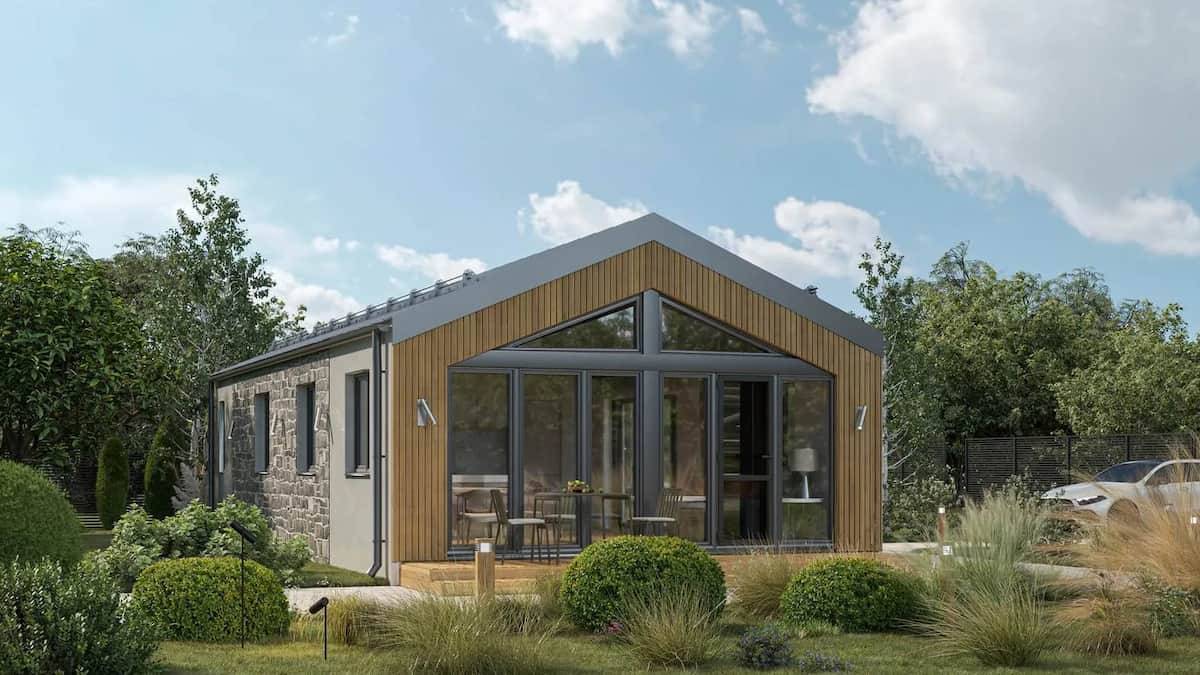
In short. A timber-frame house does not burn faster than any other, provided the wall insulation is non-combustible and the frame has been given a fire-retardant and antiseptic treatment. Walls and floor panels built with Trident Modular technology have a certified fire resistance class of REI 60: for at least 60 minutes under fire they retain their load-bearing capacity, integrity and thermal insulation. Their insulation is non-combustible Class A1 basalt wool. Most fires in private houses start with wiring, heaters and open flames, so correct electrics, safe heating and smoke alarms matter just as much.
Does a timber-frame house burn? Where the fear comes from
Most stories about houses burning down in half an hour concern old summer cabins. They were put together from untreated boards, insulated with whatever was to hand, and the wiring was run openly across the timber with no protection at all. In a structure like that, there really is nothing to stop a fire.
A modern timber-frame house is an engineered system in which every layer has its own job. A frame of dry calibrated timber, non-combustible insulation, membranes, board sheathing and interior finishes together determine how a wall behaves in a fire. That is why it makes no sense to judge its safety by old summer cabins.
Four myths about timber-frame house fire safety
These are the claims we hear from clients most often. Let’s look at what is true in them and what is not.
‘A timber house burns down in 15 minutes’
Timber burns slowly and predictably. In a fire, a layer of char forms on its surface, which conducts heat poorly and protects the inner part of the cross-section. European design standards for the fire resistance of timber structures, which have also been adopted in Ukraine, assume a charring rate for softwood of 0.65–0.8 mm per minute. In other words, after half an hour of open fire a beam chars to a depth of roughly 2–2.5 cm, while its core continues to carry the load.
What is more, in a timber-frame house the timber is not exposed to the flames: it is covered by insulation, sheathing and interior finishes. That is why walls and floors built with Trident Modular technology withstood at least 60 minutes of open fire in testing – 4 times longer than the ‘15 minutes’ in the myth.
‘The insulation in the walls burns’
It all depends on which insulation. Expanded polystyrene really does burn and melt, so it is best avoided in the walls of a timber-frame home. Basalt wool has a reaction-to-fire class of A1, meaning it is classed as non-combustible, and it melts only at temperatures above 1,000 °C. Inside the wall it acts as a fire barrier, stopping flames from spreading between the frame studs. We covered which other properties of insulation are worth comparing in our article on how to insulate a house.
‘Fire-retardant treatment is just marketing’
A fire-retardant and antiseptic product changes how timber behaves in a fire: treated wood is harder to ignite and spreads flame more slowly. These products are divided into groups by effectiveness. Deep impregnation gives Group I, while surface treatment in several coats gives Group II. Besides fire, the product protects timber from fungus, mould and insects, so the durability of the frame depends on it too. You can read more about what affects a house’s service life in our article on modular house lifespan.
‘A brick house doesn’t burn, so it’s safer’
Brick walls really don’t burn, but furniture, textiles, flooring and often the timber roof rafters do. The greatest danger to people in a fire is smoke, and it spreads in the same way in a house made of any material. So the safety of a home depends less on the walls than on whether the smoke alarm goes off in time and whether people can get outside quickly.
Want to see what the walls of our houses are made of? Visit the Trident Modular showroom in Kyiv or request a consultation – we’ll show you a wall cross-section and talk you through every layer.
What the wall is made of and how it behaves in a fire
Here is a cross-section of the external wall of a Trident Modular timber-frame house with 200 mm insulation, and what each layer does in terms of fire safety.
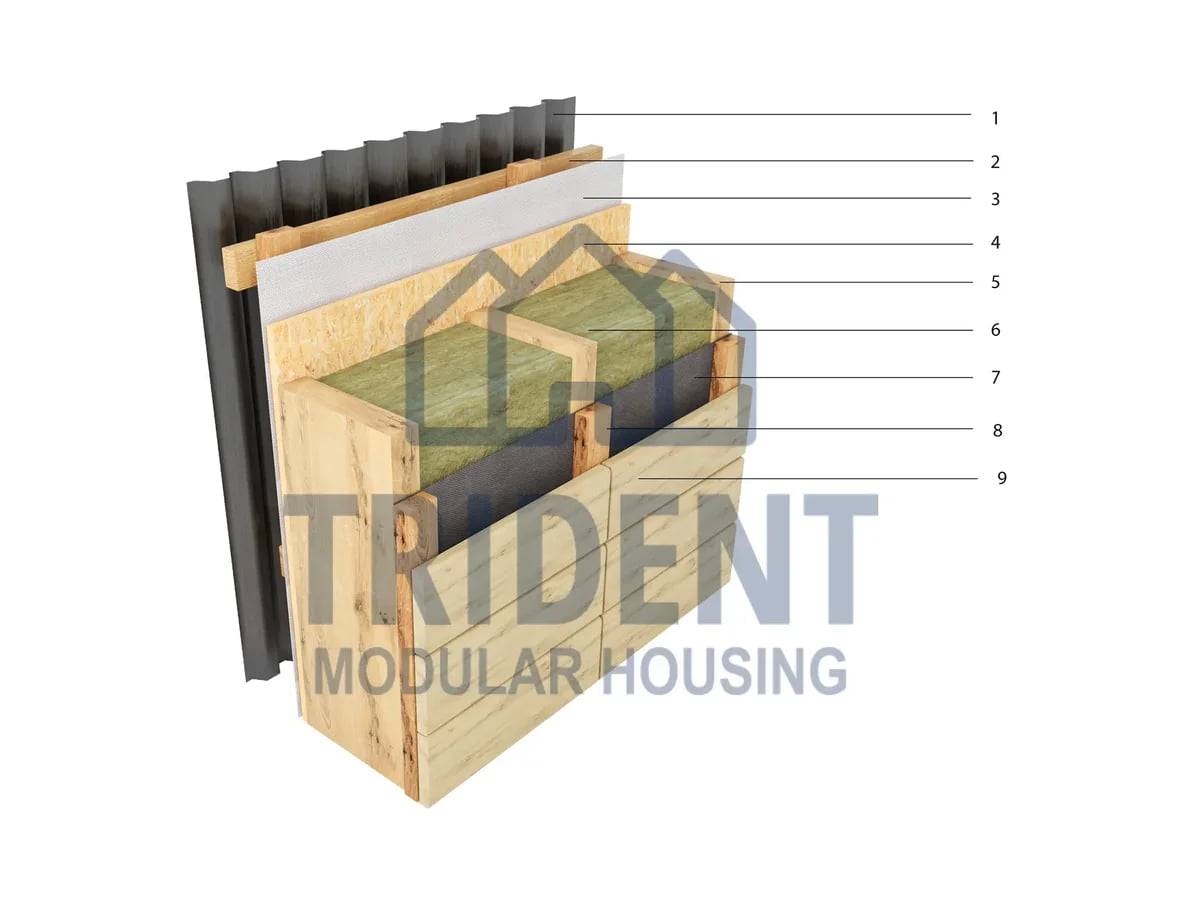
| Layer | Material | Role in fire safety |
|---|---|---|
| Façade | As per design | Non-combustible façade materials give the wall extra protection from outside |
| Diffusion membrane | Membrane | Protects the insulation from moisture so it keeps its properties |
| Sheathing | OSB-3, 12 mm | Covers the frame and makes the wall rigid |
| Load-bearing frame | C24 timber, 195 mm, with fire-retardant and antiseptic treatment | Harder to ignite than untreated timber, chars gradually |
| Insulation | A1 basalt wool, 200 mm | Does not burn and stops fire spreading inside the wall |
| Vapour barrier | Membrane | Protects the insulation from moisture from inside |
| Interior finish | As per design | The first barrier to fire inside the room |
How this structure behaves in a fire has been checked in testing. Walls and floor panels built with Trident Modular technology are certified in Ukraine with a fire resistance class of REI 60. The letters stand for three properties the structure retains for at least 60 minutes: R – load-bearing capacity, E – integrity, meaning fire and smoke do not pass through it, and I – thermal insulation, meaning the opposite side of the wall does not heat up to a dangerous temperature. You can view the certificate and test reports on our certificates page.
The roof and floor are built on the same principle: frame, basalt wool and membranes. Cross-sections for all specifications are on our technology page.
Interior finishes also affect safety. Plasterboard, tiles and painted surfaces burn less readily than exposed timber, so they are the better choice in the kitchen, the boiler room and around a fireplace. The finish specification is decided at the design stage.
Where fires really start
According to the State Emergency Service of Ukraine (SESU), the main causes of house fires are short circuits in the electrical system, misuse of heaters and careless handling of fire. During power cuts, generators, portable power stations and batteries have joined the list: the SESU notes that the number of such fires in private houses rises noticeably once power cuts begin. In other words, the risk depends mainly on what happens inside the house, not on the wall material.
So in a timber-frame house, as in any other, safety comes from:
- wiring sized for the real load: water heater, cooker, underfloor heating, air conditioning;
- cables in metal corrugated conduit or trunking so they don’t come into contact with the timber;
- circuit breakers and a residual current device (RCD) for each group of appliances;
- separate circuits for high-power appliances;
- standalone smoke alarms in the bedrooms, hallway and kitchen.
In Trident Modular turnkey houses, the electrical installation is included in the specification, so it is designed together with the house rather than added separately later. For example, in the Nest 12 modular house the wiring was run at the factory in metal corrugated conduit, with junction boxes and separate outlets for every light fitting, socket and climate control unit.
Fireplace, boiler and generator: what to consider
Open fires and fuel-burning heating are possible in a timber-frame house, but they are built into the design from the outset rather than added after construction.
- Electric heating and heat pumps. The simplest options in terms of fire safety: no open flame and no flue. We compared heating systems and seasonal running costs in our article on modular house heating.
- Pellet or gas boiler. Needs a separate plant room and a flue. The walls and floor around the boiler are finished with non-combustible materials.
- Fireplace or stove. You need a certified flue, non-combustible insulation where it passes through the floor structure and roof, and clearances from timber structures as specified by the manufacturer.
- Generator and portable power station. The generator is placed outdoors, away from windows and doors. A portable power station should not be left charging unattended near flammable items.
Planning a fireplace or boiler? Tell us about it at the consultation: we’ll build it into the design straight away, together with the electrics and finishes.
What to keep at home in case of fire
Even the safest structure cannot replace a few simple things that help you put out a fire in its early stages or get out of the house quickly.
| What to have | Why |
|---|---|
| A fire extinguisher in the kitchen and near the boiler or fireplace | To put out a fire in the first few minutes, before it spreads |
| A fire blanket in the kitchen | To smother burning oil in a pan, which must not be put out with water |
| Smoke alarms in the bedrooms and hallway | To wake you at night, when you can’t smell smoke |
| Clear exits and windows that open easily | To get out of the house quickly if the main exit is cut off |
| Access to the consumer unit | To cut the power before tackling a fire, as live electrical appliances must not be put out with water |
Check your fire extinguisher once a year: the pressure gauge needle should be in the green zone. If you can’t put out a fire within a few seconds, leave the house and call 101.
Safety on the plot
Fire safety for a timber-frame house starts with where it will stand. Fire separation distances between houses are set by DBN B.2.2-12:2019 ‘Planning and Development of Territories’, and they depend on the fire resistance rating of the buildings. That is why the position of the house on the plot is agreed, taking neighbouring buildings into account, before the order is placed.
It is also worth leaving access for a fire engine, keeping barbecues and fire pits away from walls and terraces, and mowing the grass around the house regularly, especially in summer.
What to ask your builder
To judge how safe a house will be, ask these questions before you sign the contract:
- What insulation is used in the walls, roof and floor, and what is its reaction-to-fire class?
- Is the frame given a fire-retardant and antiseptic treatment, and with what product?
- How is the wiring run, and are circuit breakers and RCDs included in the specification?
- What interior finishes are planned for the kitchen, boiler room and around the fireplace?
- Can a fireplace or boiler be built into the design, and how will the flue be installed?
If the builder gives specific answers, naming materials and layer thicknesses, that’s a good sign. We answer these questions during the consultation and show the materials in person at our showroom. If you are still choosing between technologies, read our comparison modular or timber-frame house for permanent living as well.
A safe timber-frame house: where to start
Fire safety in a timber-frame house is built in at the design stage: non-combustible insulation, a treated frame, correct electrics, safe heating and smoke alarms. Trident Modular timber-frame houses are insulated with Class A1 basalt wool, the frame of dry C24 timber is given a fire-retardant and antiseptic treatment, and the walls and floors have a certified fire resistance class of REI 60. Ready-made designs and prices are in our timber-frame houses section.
Tell us what kind of house you are planning and we’ll suggest solutions for your plot:
- Book a consultation – we’ll help you choose a design and work out the cost.
- Call us: +38 (073) 503 57 57.
- Email us at info@tridentmodular.com.ua.
- Visit our showroom in Kyiv at 2 Akademika Bulakhovskoho St (Agromat) to see a wall cross-section and the materials in person.
FAQ · 6 questions
Timber-frame house fire safety: FAQ
Short answers to the questions clients ask most often.
Does a timber-frame house burn?
The timber in the frame is combustible, but in a modern timber-frame house it is covered by non-combustible insulation, sheathing and finishes, and given a fire-retardant and antiseptic treatment. Walls and floors built with Trident Modular technology have a certified fire resistance class of REI 60, meaning they withstand open fire for at least 60 minutes.
Does basalt wool burn?
No. Basalt wool is classed as a non-combustible Class A1 material and melts only at temperatures above 1,000 °C. In a wall, it stops fire spreading between the frame studs.
Is a wooden façade safe?
Wooden façade boards are combustible, so they should be given a fire-retardant and antiseptic treatment. Behind the façade, the wall is insulated with non-combustible basalt wool, so a fire outside does not spread into the structure. If the house stands close to neighbouring buildings, you can choose a non-combustible façade, such as metal cladding.
Can you install a fireplace in a timber-frame house?
Yes, if it is planned at the design stage: you need a certified flue, non-combustible insulation where it passes through the floor structure and roof, and clearances from timber structures.
Is it safe to use a generator and a portable power station in a timber-frame house?
Yes, following the same rules as in any house: the generator is placed outdoors, and the portable power station is not left charging unattended near flammable items.
Is a timber-frame house suitable for permanent living in terms of safety?
Yes. Non-combustible insulation, a treated frame, properly designed electrics and heating, and smoke alarms make a timber-frame house safe to live in all year round.