
Heating a modular house requires a different approach than heating a brick or block-built home — and this is not marketing, but physics. A house with a factory-built thermal envelope uses about half as much energy for heating as a conventional building of the same size. However, this advantage only works when the heating system is selected according to the specific characteristics of the structure rather than installed “by analogy with the neighbour’s house.”
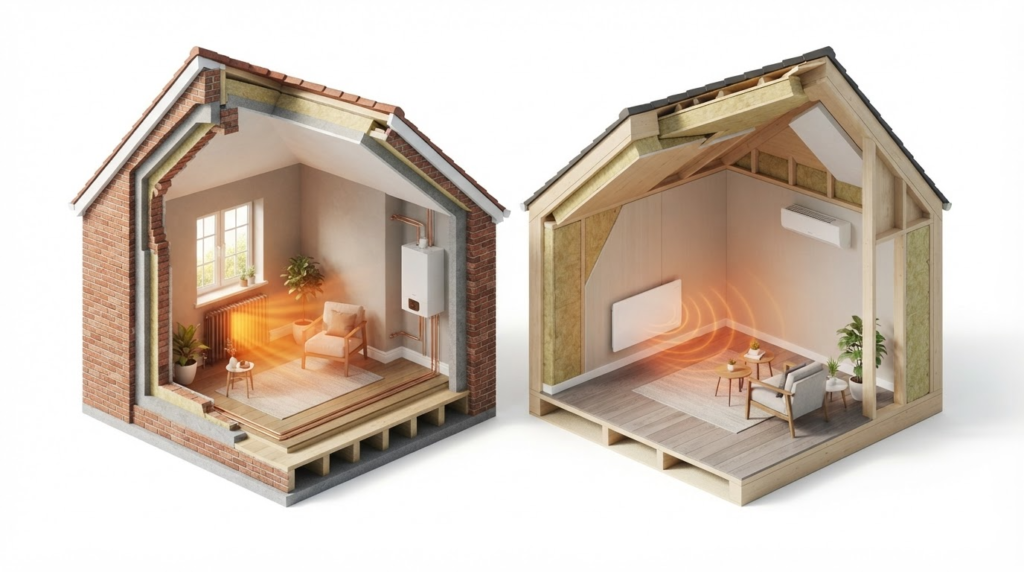
Why Heating a Modular House Differs from Heating a Traditional Home
The main difference lies not in the materials themselves, but in how the thermal envelope is designed and assembled. In traditional construction, insulation is installed by a crew directly on site, so the quality of the work depends on the people involved and the conditions on a particular day. In a modular house, the complete thermal envelope is assembled in a factory under controlled conditions, where the risk of human error at critical junctions is minimized. This changes the way heat is lost through the building and results in different requirements for heating system capacity.
Key characteristics of a modular house thermal envelope:
- Factory-sealed joints. All panel connections are sealed in the production facility, helping eliminate thermal bridges that can account for up to 30% of total heat loss in traditional construction.
- Controlled insulation thickness. Mineral wool or PIR boards with a thickness of 150–200 mm provide thermal resistance of R ≥ 4.0 m²·K/W in accordance with DBN V.2.6-31.
- Reduced heat-loss area. The compact geometry of a module reduces the ratio of the external envelope perimeter to the total floor area, allowing the house to retain heat more efficiently than a conventional elongated building.
- Factory-installed vapour and wind protection. Membranes are installed without improvised overlaps or tears on the construction site, helping prevent uncontrolled air infiltration.
- Low thermal inertia. The lightweight structure heats up within 1–2 hours rather than a full day, making it possible to use flexible heating systems with weather-based and zoned controls.
That is why, in our modular houses from the manufacturer the thermal envelope is designed and built at the production stage. Altering the wall structure after assembly is technically difficult and economically impractical. The specific heat load of a properly insulated modular house is around 40–50 W/m², compared with 80–100 W/m² for a standard brick house. This means that both the required heating capacity and energy consumption of an energy-efficient home in Ukraine are significantly lower — and choosing the right system starts with this figure.
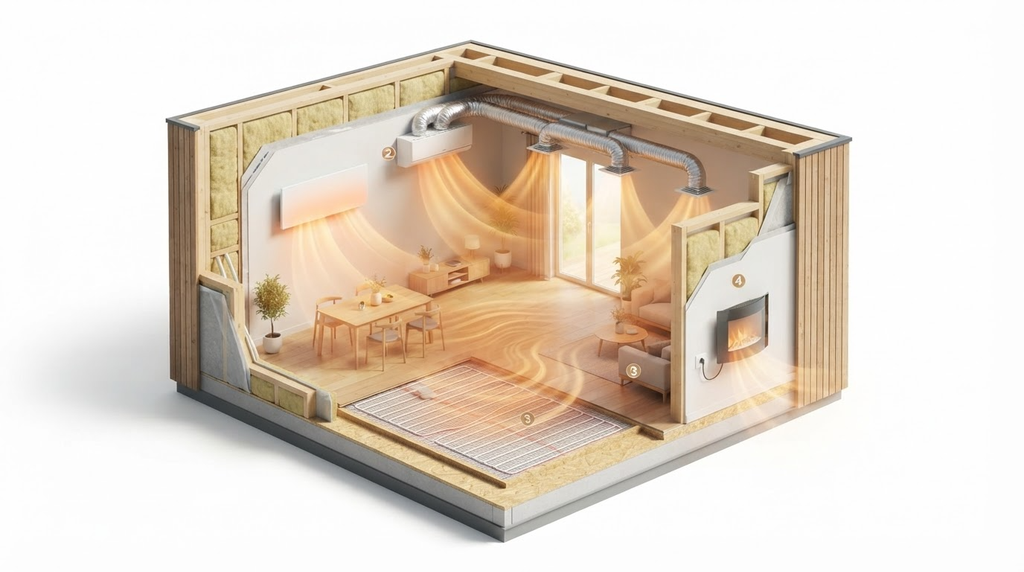
Which Heating Systems Are Actually Suitable for a Modular House
Not every system that works well in a brick house is optimal for a modular one. The main rule is that the system should match the building’s low heat load rather than be oversized “just in case.” Here are five options with specific technical parameters for an 80 m² house.
- Electric heating (convector heaters or an electric boiler). The simplest option to install — no pipework, boiler room, or dedicated technical space is required. Over one heating season, a well-insulated 80 m² house consumes approximately 7,000–9,000 kWh of electricity. This option is best suited to seasonal or occasional use when the house remains unoccupied for much of the winter.
- Air-to-water heat pump. The most efficient solution for permanent residence. The low heat load of a modular house allows a 5–8 kW heat pump to fully meet the heating needs of an 80–100 m² home. In a typical Ukrainian climate, the COP is around 2.8–3.2, meaning that each kilowatt of electricity consumed produces almost three kilowatts of heat. In practice, this results in 2.5–3 times lower electricity consumption than direct electric heating over a comparable season.
- Pellet boiler. An autonomous solution that does not depend on the gas grid. An 80 m² house typically requires 1.2–1.8 tonnes of pellets per heating season. A technical room of at least 4 m² is required for the boiler and pellet hopper, along with regular maintenance twice per season. The main advantage is that the fuel cost per unit of heat can be significantly lower than direct electric heating, even with a preferential electricity tariff.
- Infrared panels. A practical option as the primary heating system for seasonal homes or holiday houses. They require no pipework, are easy to remove, and are not affected by freezing temperatures. A single panel typically has a rated power of 0.3–0.8 kW, depending on its capacity and the size of the room. In a well-insulated modular house, infrared panels can perform more effectively than in conventional buildings.
- Hydronic underfloor heating as the main heating system. Combined with a heat pump, this is one of the most technically balanced solutions for permanent residence. The water temperature in an underfloor heating circuit typically remains within 35–45 °C, compared with 70–80 °C in a radiator system. This lower operating temperature can improve heat pump COP by 20–30%, while heat is distributed evenly throughout the space without local overheating or draughts.
Comparison of Heating Systems for a Modular House: Figures and Facts
When choosing a heating system, it is important to consider not only the complexity of installation but also the total costs over its entire service life: energy costs, dependence on infrastructure, and maintenance requirements. All figures below are based on an 80 m² house with a standard insulation level of R ≥ 4.0 m²·K/W and a six-month heating season.
| Parameter | Electric Heating | Heat Pump | Gas / Pellets |
|---|---|---|---|
| Installation complexity | Minimal — no pipework or boiler room required | High — outdoor unit, pipework, commissioning | Medium — boiler room or technical space of at least 4 m², chimney |
| Energy consumption per season (80 m²) | 7,000–9,000 kWh of electricity | 2,500–3,500 kWh of electricity (COP 2.8–3.2) | 1.2–1.8 tonnes of pellets or 800–1,100 m³ of gas |
| Dependence on infrastructure | Electricity grid only | Electricity grid only | Gas: mains supply or cylinders; pellets: fuel delivery logistics |
| Suitable for a modular house | Yes — especially for seasonal use | Yes — optimal for permanent residence | Yes — provided there is space for a boiler room |
| Maintenance | No scheduled maintenance required | Maintenance 1 a year, without complex procedures | Mandatory servicing and cleaning 2 per season |
Of the three options, electric heating offers the simplest installation but has the highest energy consumption — around 2.5–3 times more electricity per season than a heat pump under comparable conditions. A heat pump requires a higher initial investment, but for permanent residence it provides the lowest long-term seasonal heating costs. Gas and pellet systems occupy an intermediate position: the energy source can be relatively inexpensive, but they require greater dependence on infrastructure and mandatory technical maintenance twice a year.
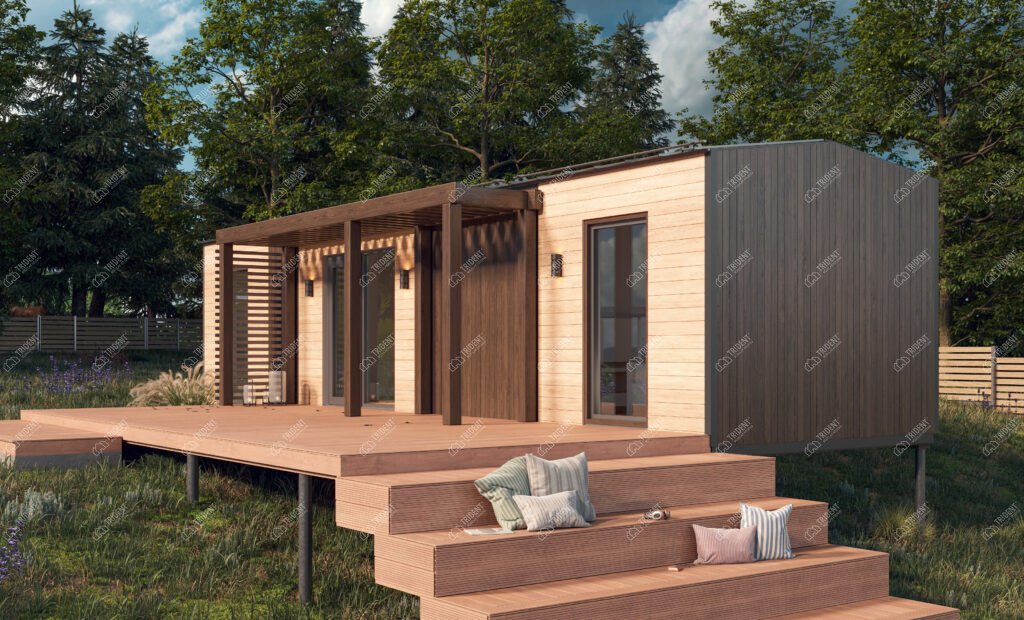
Which Heating System to Choose Depending on the Type of Property
House up to 80 m² for Permanent Residence
For permanent residence, the most suitable choice is an air-to-water heat pump combined with hydronic underfloor heating. A modular house with a specific heat load of 40–45 W/m² does not require high-capacity equipment: a 5–6 kW heat pump with a COP of around 3.0 can cover the heating demand throughout the season while consuming roughly three times less electricity than direct electric heating for a house of the same size. This format is particularly well suited to timber-frame houses for permanent residence with a factory-built thermal envelope and a prepared screed for underfloor heating.
Seasonal House or Holiday Home
For properties used irregularly — around 3–5 months a year — electric heating with convectors or infrared panels is an optimal solution. The system does not require antifreeze, winterisation, or scheduled maintenance. With occasional use, actual seasonal consumption remains relatively low, while simple installation and the absence of maintenance requirements make this solution particularly practical for this type of property.
Commercial Property or Glamping Unit
For commercial modules such as campsites, glamping units, or offices, a multi-split system or VRF climate-control system with heating capability is a suitable choice. In heating mode, with an outdoor temperature of +7 °C, COP can reach 3.5–4.0. The system provides year-round climate control in a single solution without the need for a separate boiler. The key advantage for commercial properties is the ability to control each module independently and respond quickly to temperature changes.
House Without Gas or with an Unstable Electricity Supply
If the site has no gas connection and the power supply is unstable, a practical strategy is to use a heat pump as the primary heat source with a pellet boiler or wood-burning stove as an autonomous backup. A 15 kW pellet boiler can fully cover the heating demand of an 80 m² house during power outages. This hybrid setup improves system reliability and reduces dependence on any single energy source.
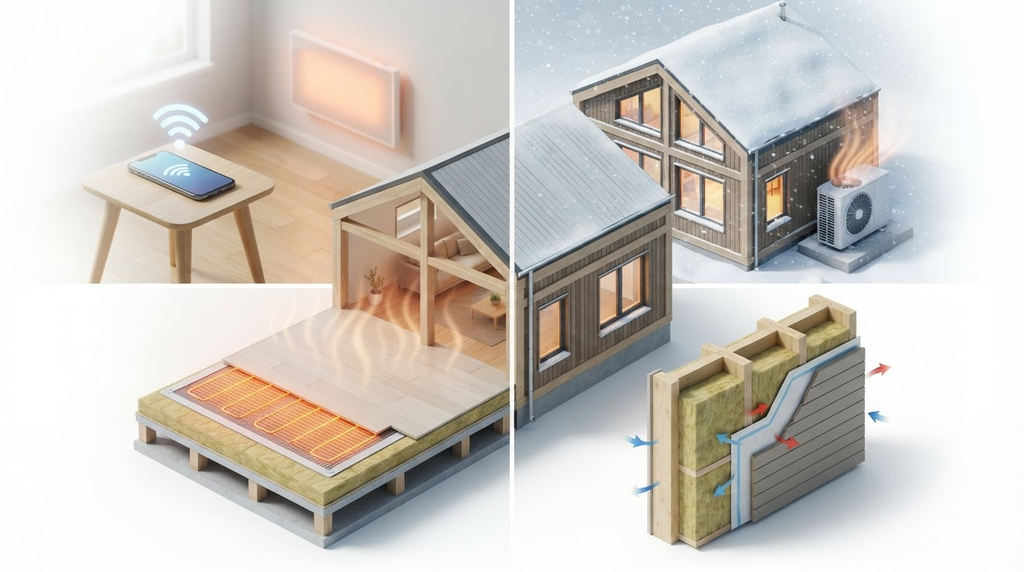
Frequently Asked Questions About Heating a Modular House
How Much Does It Cost to Heat a Modular House per Season?
The answer depends on three factors: the heating system selected, the applicable electricity tariff, and the quality of the building’s thermal envelope. For an 80 m² house with insulation that meets current standards, a heat pump consumes approximately 2,500–3,500 kWh of electricity over six months, while direct electric heating consumes around 7,000–9,000 kWh. At the same electricity tariff, the difference between these two approaches is approximately 2.5–3 times, which means that choosing the right heating system is more important than choosing a tariff plan.
Is a Heat Pump Suitable for a Modular House?
Yes — very much so. The relatively low heat load of a well-insulated modular house (40–50 W/m²) allows a 5–8 kW air-to-water heat pump to fully meet the heating needs of an 80–100 m² home, even during the coldest months. A COP of 2.8–3.2 in a typical Ukrainian climate means that for every kWh of electricity consumed, the system produces almost 3 kWh of heat — and these are realistic operating figures rather than maximum values stated in the specifications.
Which Heating System Is the Easiest to Install?
Direct electric heating — convector heaters or an electric boiler. There is no need for extensive pipework, a dedicated technical room, or commissioning by a certified specialist: the system can be ready to operate on the day of installation. Infrared panels are even simpler — they can be mounted on a wall or ceiling and connected to a standard electrical outlet. By comparison, a heat pump requires installation of an outdoor unit, pipework, and system balancing, typically taking 2–5 days with a qualified installation team.
Can a Pellet Boiler Be Used in a Modular House?
Yes, provided there is enough space for it. A technical room of at least 4–6 m² for the boiler and pellet hopper, together with a properly installed chimney, are essential requirements. A 15 kW boiler can cover the heating demand of an 80 m² house even during the coldest weeks of the season, while pellet consumption is approximately 1.2–1.8 tonnes per season. The system is completely independent of the gas grid and can be a practical choice for sites without a gas connection.
How Does Insulation Thickness Affect Heating Costs?
The relationship is direct: the lower the thermal resistance of the wall, the more energy is required to maintain the indoor temperature. A modular house with walls rated at R = 4.0 m²·K/W consumes approximately 40–50 kWh/m² per year, while a house with R = 2.0 m²·K/W may consume twice as much. For an 80 m² house, this represents a difference of around 3,200–4,000 kWh per season — the additional energy that insufficient insulation can consume each year. This is why insulation thickness in the specification is not simply another line in a commercial proposal, but one of the main factors determining heating costs throughout the building’s service life.
Heating a Modular House: How to Choose the Right System and Avoid Overpaying
The right heating system is one that matches the heat load of the specific house, its usage pattern, and the available infrastructure — not simply the system that is cheapest to install or the most powerful on paper. It is best to plan the heating system at the turnkey house design — stage, as this helps avoid costly alterations once the structure has already been assembled and the floor screed has been poured. Contact us for a consultation: we will help you choose the optimal heating solution for your modular house based on the type of property, usage pattern, and available utility connections.