In the evening, the power goes off in the village. Next door a generator starts up, and someone is looking for a torch. But at your place the boiler is running, the kettle is heating up, and the router has not even noticed that the grid is gone. That is what an energy-independent home looks like: it generates its own electricity with a solar power system, stores it in batteries and has a backup for overcast winters.
At Trident Modular, we manufacture modular houses at our own production facility. We do not install solar power systems, but we often hear the same thing from clients: “I want the house to be ready for autonomy”. In this article, we explain how such a system works, how to calculate it and what to plan into the house design before the solar installers get to work.
In brief. For a private house, the most practical solution is a hybrid solar power system: it cuts your bills every day, and during an outage it switches the house to batteries by itself. In the Kyiv region, 1 kW of panels generates about 1,175 kWh a year, which is 3.2 kWh a day on average. For consumption of 250 kWh a month, you will need a system of roughly 2.5–3 kW. To keep a fridge, lights, a router and a pump (about 0.5 kW combined) running for 8 hours without the grid, you need 4.5–5 kWh of battery capacity. In December, panels produce almost 7 times less energy than in July, so winter calls for a backup: the grid or a generator.
Contents
- What an energy-independent home is and who needs one
- How to make a house energy-independent: 6 steps
- What happens in winter: calculations for three houses
- Why a modular house is easy to prepare for autonomy
- Which solar power system to choose for a house
- What autonomy costs and where you can save
- Common mistakes
- Frequently asked questions
What an energy-independent home is and who needs one
An energy-independent home rides out power cuts so smoothly that the people living there hardly notice them. Panels on the roof alone do not make a house energy-independent: a grid-tied solar power system without batteries shuts down together with the grid during a blackout.
The system has four parts. Panels generate energy. Batteries store it. An inverter converts the current to the usual 220 V and switches between sources by itself. A generator provides cover during overcast winter weeks. If there is no grid at the plot at all, the house is called off-grid: this system is its only source of power.
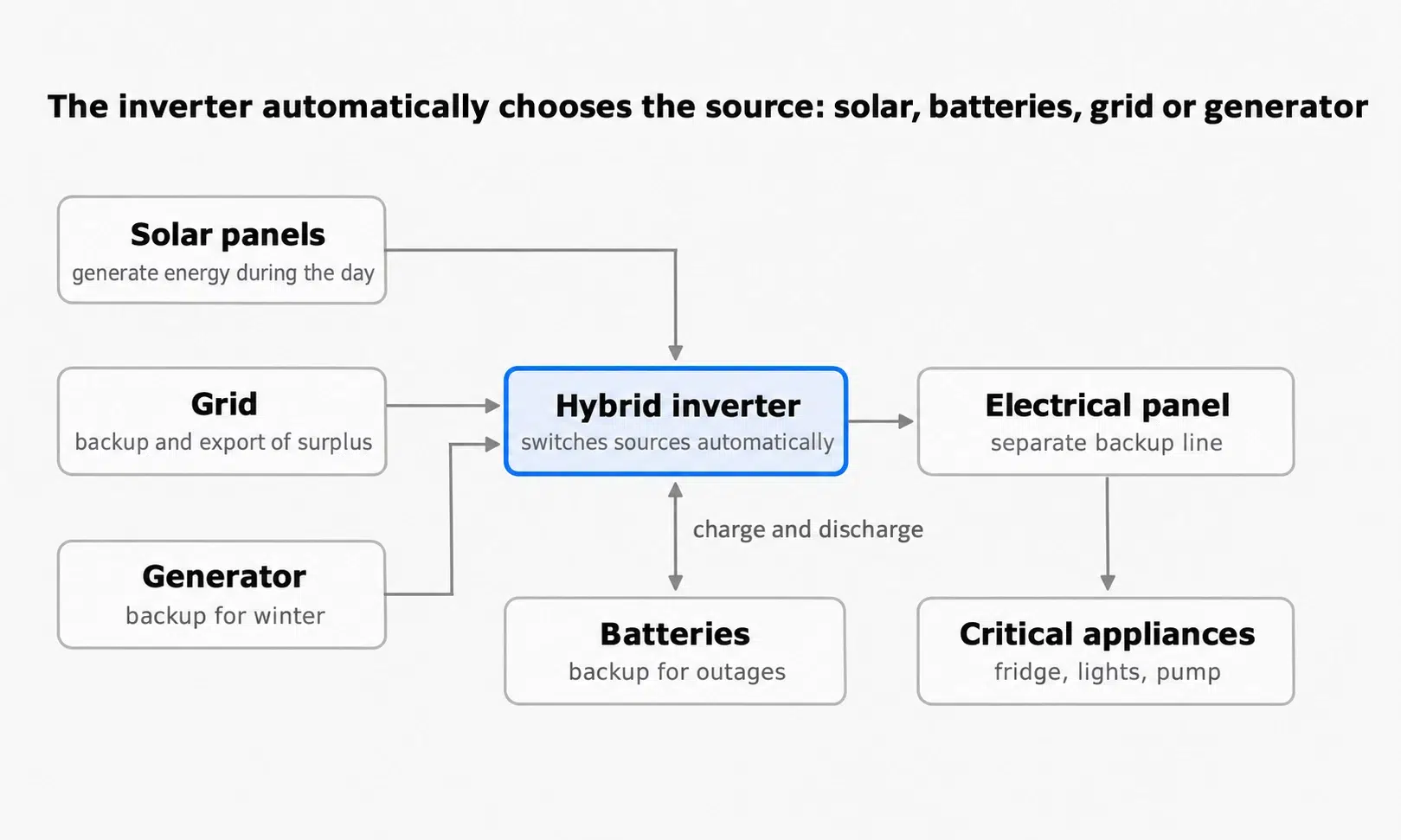
People most often start thinking about autonomy in these situations:
- Regular power cuts. The house has to keep the lights, communications, the pump and the fridge going for 6–12 hours without the grid.
- A plot with no grid. The plot is beautiful, near a forest or water, but the nearest line is a kilometre away and connecting costs more than your own solar power system.
- A hospitality business. For a holiday park or glamping site, a dark cabin means an unhappy guest and a bad review.
- Electric heating. If the house is heated by a heat pump or an electric boiler, it is not only the lights but also the heat that depends on the grid.
How to make a house energy-independent: 6 steps
1. Start with your electricity bills
Equipment is chosen once it is clear how much energy you need. Take a year of bills and look at two months: the hottest and the coldest. For a new house, list the appliances with their power ratings and hours of use.
Separately, write down what you cannot comfortably go without even for an hour: the fridge, lights, router, pump and boiler. These are the critical loads, and the batteries are sized for them. One evening is enough for this step.
2. First a warm house, then panels
Energy that the house does not lose does not need to be generated. If heat escapes through the walls, floor and roof, no system will make the house truly autonomous. That is why everything starts with insulation, windows and an airtight envelope.
A modular house has the advantage here: the modules are assembled in a factory, so the quality of the insulation does not depend on rain or frost on site. Every kilowatt-hour saved means fewer panels and fewer batteries.
3. Choose a system type
If the plot has a grid connection, the smartest option is a hybrid system. It cuts your bills every day, and during an outage it switches the house to batteries in a fraction of a second. Without a grid, you need an off-grid setup with a generator. The types are compared in the table below.
4. Calculate the system and the batteries
According to the Solar Energy Association of Ukraine, 1 kW of panels installed at a 35° tilt facing south generates from 1,120 to 1,450 kWh a year, depending on the region. For the Kyiv region, that is about 1,175 kWh, or 3.2 kWh a day on average over the year. A house that consumes 250 kWh a month (3,000 a year) will need a system of roughly 2.5–3 kW.
Battery capacity is calculated differently: the power of the critical appliances is multiplied by the length of the outage. A fridge, lights, a router and a pump together consume about 0.5 kW. For 8 hours without the grid, that is 4 kWh, and with a 10–20% margin it comes to 4.5–5 kWh. The exact specification is drawn up by the company that will install the system.
5. Plan space for the equipment in the house design
A system can also be fitted to a finished house, but then you will have to chase the walls, run cables along the facade and rework the consumer unit. It is simpler to take this into account at the design stage:
- a south-facing roof with spare load-bearing capacity for the panels;
- a dry utility room for the inverter and batteries;
- cable ducts from the roof to the utility room;
- a consumer unit with a separate line for critical appliances.
In a modular house, the internal wiring is installed at the factory, so these requests should be raised before manufacturing begins. The house will then arrive on the plot already prepared for the future system.
6. Leave the installation to a specialist company
The panels, inverter, batteries and auto-start generator are installed by a company that specialises in solar energy. Installing a home system of up to 10 kW usually takes 1–3 days. The generator on this list is there for December, when there is little sun and the outages are long. If you plan to sell surplus energy to the grid, you need active consumer status and a bidirectional meter: the application goes to your distribution system operator.
What happens in winter: calculations for three houses
Before buying a system, everyone asks what will happen in winter. The sun still works in December, but only weakly. In the Kyiv region, 1 kW of panels produces about 154 kWh in July and only 22 in December.
That is almost a sevenfold difference. Practitioners give similar estimates: the technical director of Atmosfera believes that a solar power system can cover about 70% of annual consumption, while the rest, which falls in winter, has to come from another source. That is why the calculation always has two parts: a system for the year and a backup for the winter.
Here are three typical scenarios for the Kyiv region. The figures are approximate and show the logic of the calculation:
| Summer house, 50 m² | House, 100 m², gas boiler | House, 100 m², heat pump | |
|---|---|---|---|
| How it is used | Seasonally, April–October | All year round | All year round, electric heating |
| Consumption | 100–150 kWh a month | About 250 kWh a month | 250 kWh plus heating, many times more in winter |
| Solar power system | 1–1.5 kW | 2.5–3 kW | 6–10 kW |
| Batteries | 3–5 kWh | 5–10 kWh | 10–15 kWh |
| What happens in December | The house is closed for the season | A 3 kW system gives about 67 kWh, roughly a quarter of the demand | The system covers a small share, the grid is the main source |
| Backup | Not essential | Grid, generator desirable | Grid and generator essential |
The more a house depends on electricity in winter, the more important a warm envelope and a backup become. A few extra panels on the roof will not solve this problem. We have covered modular house heating and real seasonal costs separately.
Why a modular house is easy to prepare for autonomy
Autonomy can be added to any house. But adapting a finished house to a solar power system is harder than designing it around the system from the start. In modular construction, the second route comes naturally.
Factory production. Trident Modular modules are made at our own production facility: the insulation, windows and building envelope are installed indoors, regardless of the weather. A house with low heat loss needs a smaller system and fewer batteries.
A layout to suit your needs. Any design can be adapted. We place the utility room for the inverter, the roof orientation for the panels and the separate line for critical appliances wherever suits you.
Plots with no grid. A house on water, a holiday park by a forest or a glamping site is often located where a line cannot be run or would be very expensive to run. For such projects, autonomy is built in at the very start of the design.
Timelines. A modular house is manufactured and installed much faster than a conventional one, so the system’s turn comes within months, not after several building seasons.
Planning a house and already thinking about autonomy? You do not need ready answers. Tell us how you plan to live in the house and what has to keep working during outages. We will choose a layout and plan space for the equipment in the design, so that the system can later be installed without any rework.
Which solar power system to choose for a house
In pictures, all three types look the same: panels on a roof. You can only see the difference when the lights go out. For safety reasons, a grid-tied inverter without batteries shuts down together with the grid, so it is not suitable for energy independence.
| System type | What happens in an outage | Who it suits |
|---|---|---|
| Grid-tied (on-grid) | The system shuts down, no power | Those who only want to cut their bills |
| Hybrid | The house switches to batteries automatically | Country houses connected to the grid |
| Autonomous (off-grid) | Nothing changes, there is no grid in the system | An off-grid house, a holiday park, a plot with no line |
For most country houses, a hybrid setup is the best choice: on ordinary days it saves money, and during outages it keeps the house powered.
What autonomy costs and where you can save
The cost of an energy-independent home depends not on its floor area but on how much energy it consumes and how many hours it has to run without the grid. Two 100 m² houses may need completely different systems.
The most expensive part of the system is the batteries. Lithium iron phosphate (LiFePO4) batteries cost more upfront but withstand many times more charge cycles, so they work out cheaper over their service life. Next come the panels, the hybrid inverter and the generator. The cost of the system itself is calculated by the company that will install it.
You can save the most on two things unrelated to the equipment. A warm house needs a smaller system. And cable ducts, a utility room and a consumer unit planned into the design cost less than reworking a finished house.
State support
As of October 2026, households can take out a loan for a hybrid solar power system through authorised banks: up to UAH 480,000 for a term of up to 10 years. The state reimburses either all of the interest or 30% of the principal. The programme covers systems of up to 10 kW and also includes inverters, batteries and installation.
Bear in mind that you cannot sell energy to the grid while the subsidised loan is active. Programme terms change, so check them with your bank before applying.
Common mistakes on the way to autonomy
A grid-tied system instead of a hybrid. The owner installs a cheaper on-grid system and is left without power at the very first outage. If autonomy is the goal, you need a hybrid inverter and batteries from the start.
Calculating from the summer months. The system is sized for July, when there is plenty of sun. In December, 1 kW of panels in the Kyiv region gives only about 22 kWh, compared with 154 in July. Batteries and a generator should be sized for the hardest month.
Cheap batteries. Batteries with a short service life lose capacity faster and soon need replacing. The upfront saving turns into a second purchase.
A cold house. There are plenty of panels but still too little energy, because the house is losing heat. Insulate first, then add a solar power system for the house, and you will need fewer panels.
Sorting out energy after moving in. It then turns out that there is nowhere to run the cables, the consumer unit needs reworking and the batteries have to go in the hallway. The same decisions made at the design stage would have cost less and looked tidy.
Power without outage schedules starts with the design
An energy-independent home consists of a warm envelope, a hybrid system, batteries for the important appliances and a backup for winter. The earlier these decisions go into the design, the smaller the system you will need and the easier it will be to install.
Start with a list: how much you consume and what has to keep working during outages. Bring it to our showroom or leave a request for a consultation. We will select a modular house, standard or custom-designed, and take everything into account so that the system can be connected without any rework.
Frequently asked questions about energy-independent homes
Can a house run with no grid at all?
Yes. An off-grid house runs on a solar power system, batteries with spare capacity and a generator for the winter months. If the plot has a grid connection, it is not worth giving it up: in a hybrid setup, it becomes the backup.
What capacity of solar power system does a house need?
In the Kyiv region, 1 kW of panels generates about 1,175 kWh a year. So for consumption of 250 kWh a month, you need a system of roughly 2.5–3 kW. A house with a heat pump or electric boiler will need a system several times more powerful.
How long will the batteries last?
5 kWh of batteries will power a fridge, lights, a router and a pump (about 0.5 kW combined) for roughly 8–10 hours. For longer outages, the capacity is increased or an auto-start generator is added.
Do solar panels work in winter?
They do, but much less effectively: in the Kyiv region, 1 kW of panels produces about 22 kWh in December and about 154 kWh in July. In winter, the batteries, the grid or a generator carry the main load.
Can a solar power system be installed on a modular house?
Yes. It is best to plan it into the house design: the roof load, a utility room for the inverter and batteries, cable ducts and a separate line in the consumer unit. The system itself is installed by a specialist company.
Can a house on water be made energy-independent?
Yes, and it is often the only option, because running a grid connection to a house on water is difficult. An off-grid setup with batteries and a generator suits it. The roof area for the panels and the space for the equipment are taken into account at the planning stage.