
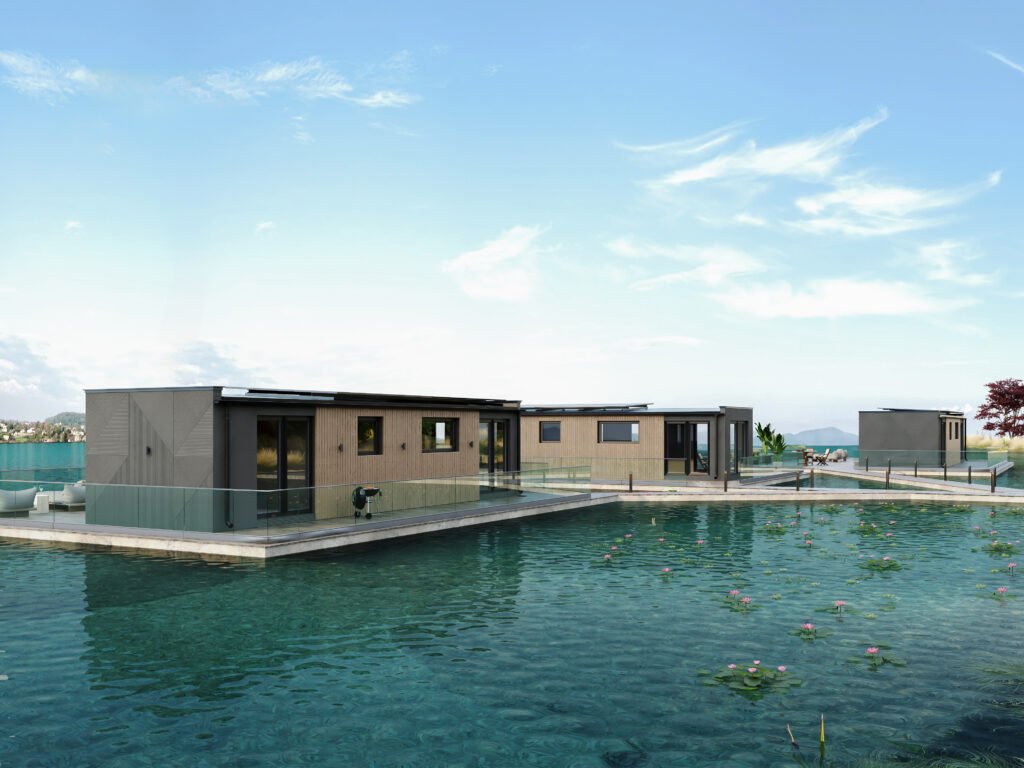
Houseboats in Ukraine have long gone beyond the seasonal format for recreation. They are used as private housing, part of hotel complexes or recreational projects. This format combines proximity to nature, flexible planning scenarios and the ability to implement non-standard residential or commercial space.
Before choosing this type of housing, it is important to understand not only the cost of the house, but also the features of the design, installation, engineering, and operating conditions. In a house on the water, the pontoon base, mooring, ventilation, seasonality of use, and the characteristics of the location itself are important.
In this article, we will consider the features of placing a house on the water as a parking vessel: installation, legal aspects, engineering, and factors that affect the comfort of living.
Implementation stages from concept to occupancy
Developing a concept early in the implementation process affects not only the architecture, but also the scenario of the future use of the facility. A house on the water requires a different approach to design than a classic dwelling on a foundation, since it is important to consider not only the appearance, but also the stability of the structure, engineering systems, and operational features.
A house on the water is not just a residential module
In such projects, even the location of technical areas or engineering systems can affect the load balance and the overall feeling of stability within the space. That is why development of a house on the water project usually starts not with the facade, but with an analysis of the location itself and operating conditions.
Expert Advice Trident Modular
For houses on the water, the location itself often determines technical solutions even before the design begins. The type of reservoir, mooring method, and access to utilities can affect both installation times and subsequent operating comfort.
How does a house on the water differ from a classic house?
The main difference is not in the format of the dwelling, but in the environment in which the structure operates. Water creates constant humidity, temperature changes, wind load and seasonal changes in water level. Because of this, even familiar architectural solutions need to be adapted.
In a house on the water, the effects of moisture and condensation usually become noticeable sooner than in a classic house. That is why it is important to think through not only the architecture, but also the ventilation, insulation, engineering, and the scenario of space operation at the start of the project.
Implementation logistics also affect installation times and complexity of work. Some processes are difficult to perform directly on the reservoir, so modular construction format often allows less dependence on weather conditions and faster installation.
Features of the design of a house on the water
The comfort of living in a house on the water largely depends on the stability of the pontoon base, mooring conditions and the characteristics of a particular body of water. The feeling inside the space is shaped not only by the structure itself, but also by the load balance, pontoon type, mooring systems and operating scenario.
With proper design and selection of a pontoon base, a house on the water is perceived as a full-fledged living space without noticeable discomfort during permanent residence. At the design stage, the following are usually taken into account:
- weight of the house;
- number of people;
- location of furniture and technical areas;
- snow load;
- engineering systems and tanks.
Because of this, the layout of a house on the water is not just a matter of design. Even the location of technical rooms or engineering systems can affect the balance of the structure and overall comfort of operation.
It is the operating characteristics that have the greatest impact on how comfortable a house will be during permanent residence. This is especially noticeable in winter, when the load on ventilation, insulation, and engineering systems increases.
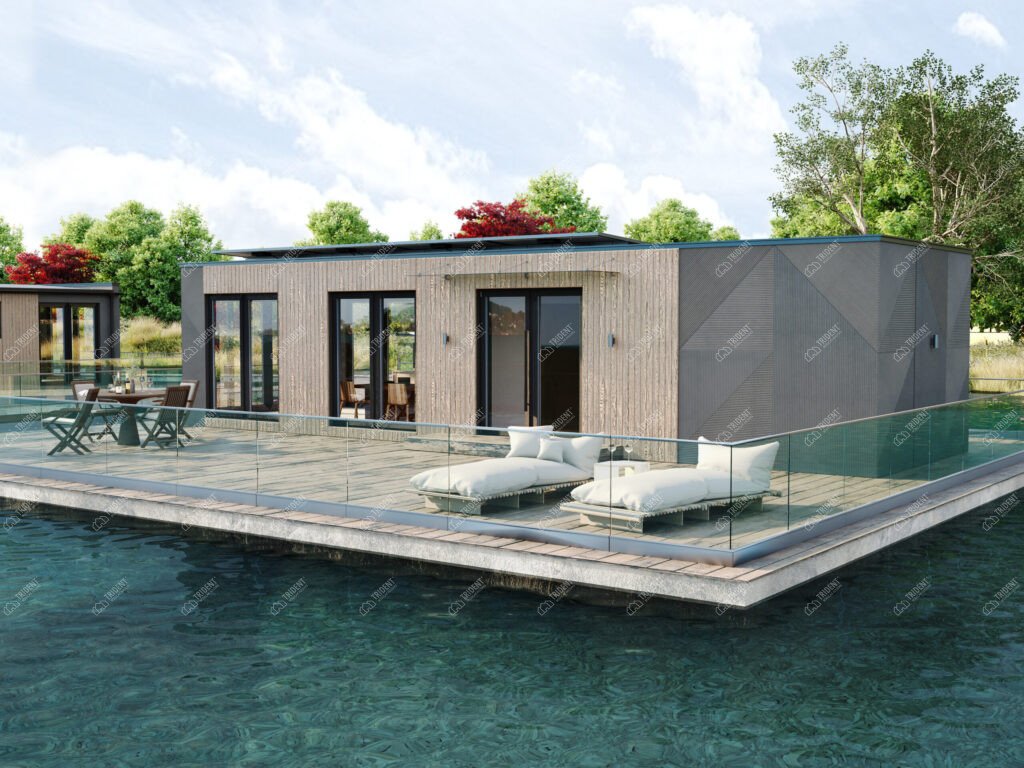
Is it possible to live in a house on the water in winter?
A house on the water can be used for permanent residence throughout the year, if insulation, ventilation, and engineering systems are taken into account at the design stage.
Winter comfort here depends not on a single solution, but on how the structure, ventilation, and glazing work together. These are the elements that have the greatest impact on the microclimate inside the house during permanent residence.
Insulation and tightness
Wind and humidity are felt more strongly on the water than on land, so the level of insulation and tightness of the structure directly affect the comfort of living in the winter.
For permanent residence, not only the thickness of the insulation is important, but also the tightness of the joints. If the joints or adjacencies are made without taking into account the operating conditions, the house may lose some of the heat even with a sufficient layer of insulation.
Ventilation and humidity
In a warm space above water, the humidity level is usually higher than in a classic house. Because of this, without proper air exchange, condensation builds up faster and over time affects the microclimate inside the room.
For this reason, it is important to think through the ventilation system before the start of module production.
Panoramic glazing and heat loss
Panoramic windows create a feeling of open space and visual contact with the water. But for permanent residence, it is important to choose the right double-glazed windows, since a large area of glazing affects both heat loss in winter and overheating of the room in summer.
What permits are needed for a house on the water in Ukraine?
There is no single design scheme for houses on the water. The requirements usually depend on the type of body of water, the method of mooring, and the format of use of the facility.
The legal part also depends on the status of the territory, communication connections and local restrictions regarding the coastline. As a result, even projects of similar format may have different implementation conditions depending on the specific location.
In practice, the following are important:
- type of reservoir;
- mooring method;
- format of use — private or commercial;
- the possibility of connecting communications;
- access to coastal infrastructure;
- local urban planning restrictions.
One of the most common difficulties in such projects is not related to the building itself, but to the characteristics of a particular body of water and the possibility of organizing mooring.
If the facility is planned for permanent residence or commercial use, it is better to evaluate the technical and legal nuances before the start of design.
Where to check legal and technical requirements
Since the requirements for placing a house on the water may depend on the type of reservoir, mooring method, and status of the territory, it is worth separately checking the current local restrictions and technical requirements before implementing the project.
Useful official resources:
- Legislation of Ukraine
- State Inspectorate of Architecture and Urban Planning of Ukraine (DIAM)
- Public Services Guide Action
What does the cost of a house on the water depend on?
The final cost of a house on the water is not only determined by the area of the residential module. The budget is also affected by the pontoon base, engineering, installation logistics, communications, and the specifics of the location itself.
Pontoon, area and equipment
The total cost usually includes:
- pontoon base;
- residential superstructure;
- insulation;
- engineering systems;
- glazing;
- decoration;
- delivery;
- installation;
- connection of communications;
- preparation of the mooring site.
Therefore, two projects of similar size can differ significantly in budget depending on the equipment and implementation conditions.
Engineering and location preparation
Another factor that affects the budget is the preparation of the location itself. In water projects, separate costs may be required:
- pier;
- coastal infrastructure;
- equipment entrance;
- engineering connection points;
- installation logistics.
As an example of a compact residential format, you can look a Aqua projectwhere the approach to organizing space for living on the water is clearly visible. For a greater emphasis on panoramic glazing, a terrace and open planning, you can also view the Riva project, реалізований у форматі сучасного будинку на воді.
Expert Advice Trident Modular
For houses on the water, the final cost often depends not only on the area of the living area, but also on the characteristics of the location itself. Preparing the mooring site, installation logistics, and connecting utilities sometimes affect the budget no less than the construction of the house itself.
To get a realistic calculation of a house on the water, it is important to consider not only the area, but also the format of use, the type of pontoon, and the features of a specific location.
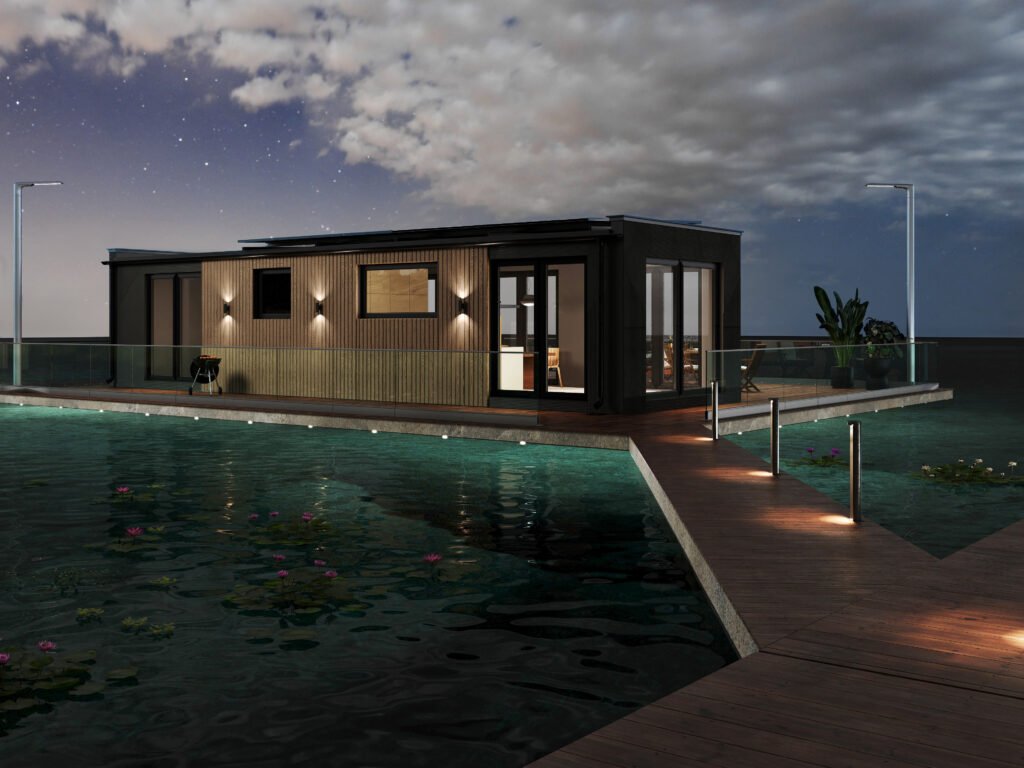
Are houses on the water suitable for business and rental?
Houses on the water are increasingly being used not only as private residences, but also as part of hotel, SPA, or rental projects.
What formats are houses on the water suitable for?
Such objects are often used for:
- hotels;
- SPA centres;
- holiday resorts;
- restaurants;
- private rental.
Because of this houses on the water increasingly being seen as a solution for hotels, resorts and rental businesses.
What is important for commercial operation
For commercial properties, it is important to consider separately:
- service access;
- noise insulation;
- ventilation;
- wear resistance of materials;
- engineering maintenance;
- peak load scenarios.
In projects for rental or hotel use, technical solutions particularly affect the subsequent comfort of guests and the stability of operation.
That is why for commercial water projects, technical solutions are usually thought out at the concept stage - before the start of production or installation of the structure.
What to check before starting a house on the water project
Before approving the project, it is worth separately assessing:
- type of reservoir;
- access to the location;
- mooring possibility;
- seasonality of residence;
- connection of communications;
- coastline features;
- type of pontoon base;
- installation logistics;
- format of use — private or commercial.
What is important to consider before selling a house on the water
In most water projects, the comfort of living and the complexity of implementation depend not on a single solution, but on a combination of design, engineering, features of the reservoir, and the space use scenario.
| Question. | What is important to consider |
| Accommodation in winter | insulation, ventilation, glazing |
| Allow | type of reservoir, mooring, territory status |
| Cost | pontoon, engineering, communications |
| Business | service access, noise insulation, load |
If it is difficult to assess which format of a houseboat is suitable for a specific location or usage scenario, it is better iscuss at the concept and preliminary calculation stage project.
FAQ — frequently asked questions
Is it cold to live in a house on the water in winter?
No, if the house is originally designed for year-round living and has appropriate insulation, ventilation, and engineering.
What communications can be connected?
Houses on the water can be connected to electricity, water supply and sewage. In some cases, autonomous systems are used depending on the location.
Can I change the layout to suit myself?
Yes. Most modern solutions allow you to adapt the space for living, rental or commercial use.
Do you need a foundation for a house on the water?
A classic foundation is not used. The basis is a pontoon or a special floating platform designed for a specific load.
Can a house on the water be built on any body of water?
Not every reservoir is suitable for such a project. The type of reservoir, local restrictions, access to the location, method of mooring, and the ability to connect communications are all important factors.